Key facts
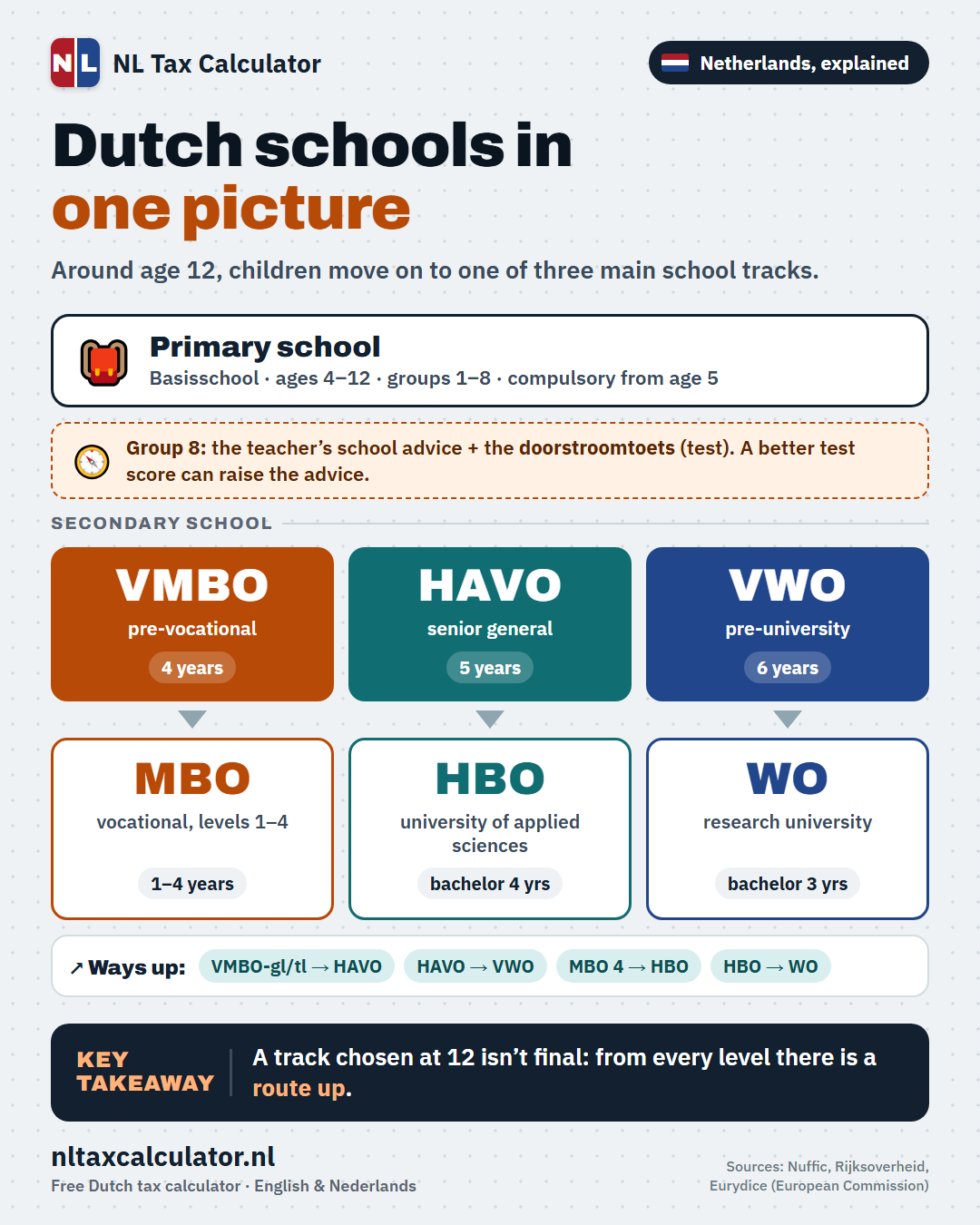
The path through school
- 0 to 4Childcare and preschool
Daycare (kinderdagverblijf) is paid, with childcare allowance for working parents.
- 4 to 12Basisschool, groups 1 to 8
Most children start on their fourth birthday. Primary school is free; schools may ask a voluntary parental contribution.
- Group 8School advice and the doorstroomtoets
The teacher gives a school advice; the national doorstroomtoets can raise it, never lower it.
- 12 to 16/18Secondary: vmbo, havo or vwo
Three main levels, sometimes combined in the first years (brugklas).
- 16+Mbo, hbo or university
Vocational training, universities of applied sciences, or research universities.
The three secondary levels
| vmbo | havo | vwo | |
|---|---|---|---|
| Years | 4 | 5 | 6 |
| Focus | Practical and vocational | General, applied | Academic (atheneum or gymnasium) |
| Leads to | mbo | hbo | university (wo) |
| Switching | Up to havo possible | Up to vwo possible |
Switching up a level is possible, and many students take a longer route (stapelen). The Dutch system sorts early, so the group 8 advice matters, but it is not final.
Higher education
Vocational education at four levels, often combined with work placements (bbl or bol).
Universities of applied sciences (hogescholen): four-year bachelors aimed at a profession.
Research universities: three-year bachelors and one- or two-year masters.
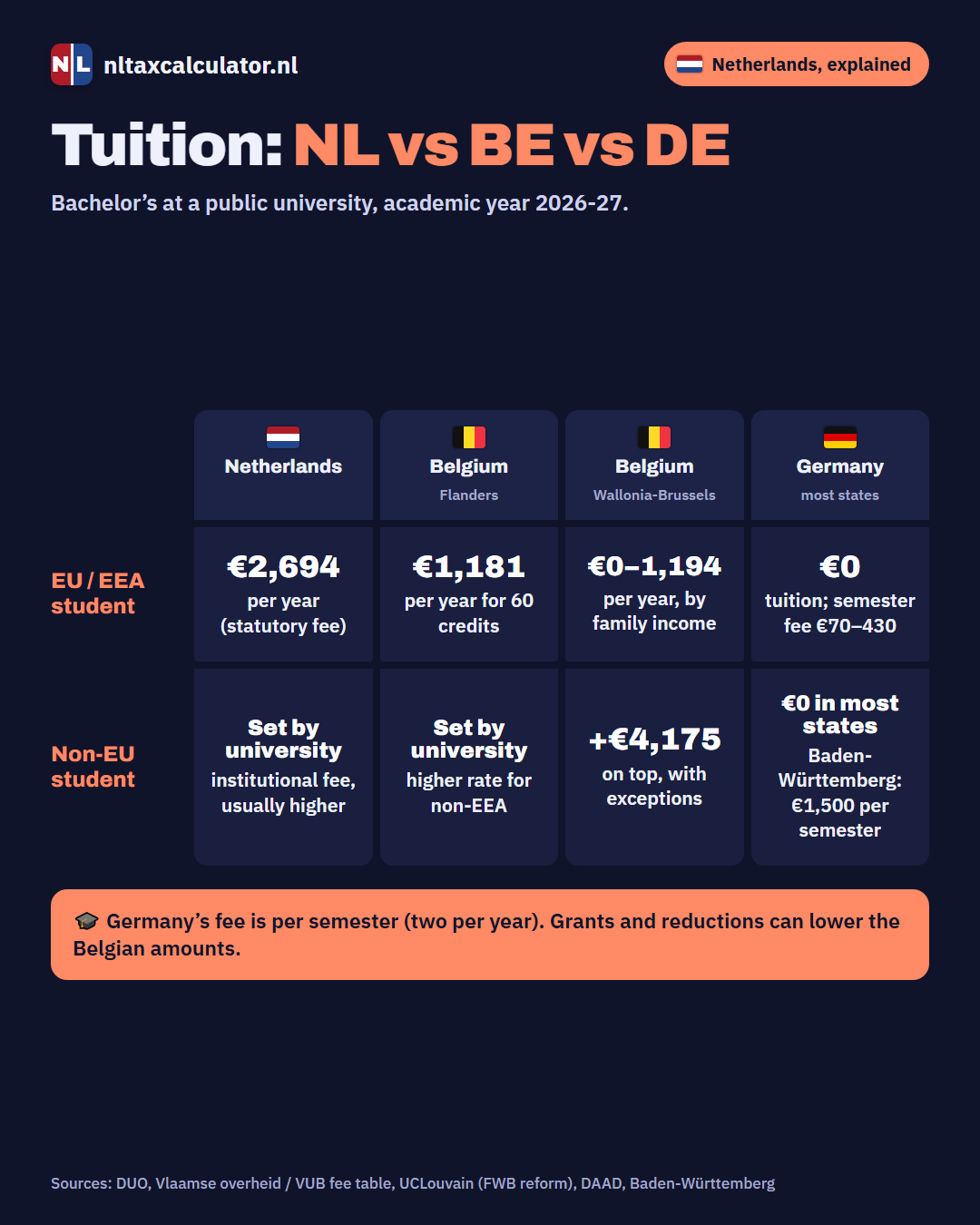
Choosing a university? See Dutch universities for the list, the application steps and student finance.
For international families
- Public Dutch school
- Free, and children usually learn Dutch quickly. Some cities have newcomer classes (taalklas).
- Bilingual school (tto)
- Dutch secondary schools teaching part of the curriculum in English.
- International school
- Subsidised Dutch international schools (DIS) charge moderate fees; private ones charge more.
- English skills
- The Netherlands ranks first in the EF English Proficiency Index.
Sources
This article is based on these official pages. If anything here differs from them, the official page is right.